Externally worn prosthetic hands have greatly improved cosmetically over the years, enabling them to look more like a regular human hand. However, most prosthetic hands still lack natural movement and sensory feedback, which are crucial components people need for everyday functions.
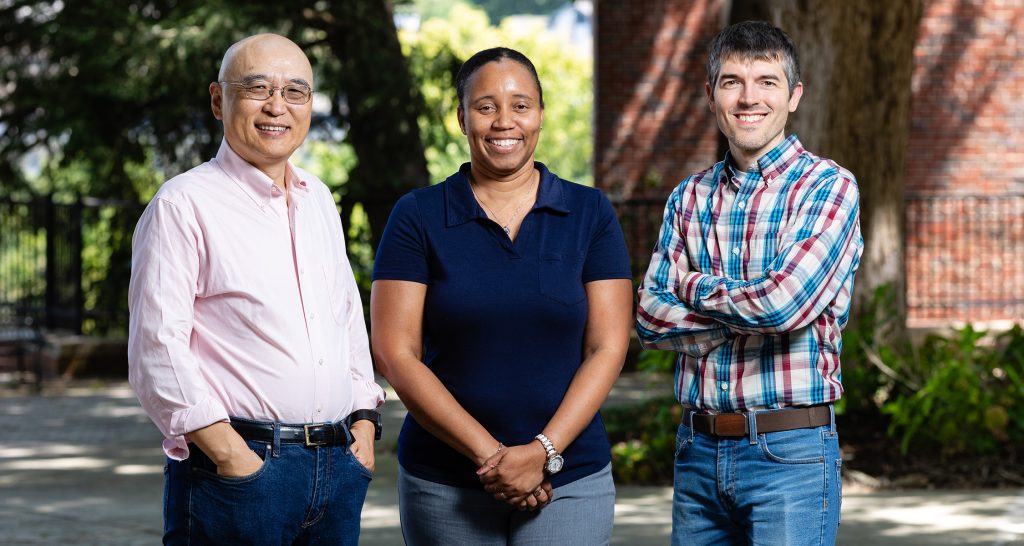
Tickle College of Engineering Associate Professor Dustin Crouch (Department of Biomedical Engineering), Professor Jindong Tan (Department of Biomedical Engineering), and ADVANCE Professor Nicole McFarlane (Min H. Kao Department of Electrical Engineering and Computer Science) have launched a project to develop and test the Myo-Bridge, a novel implantable robotic device that creates a virtual mechanical link between an amputee’s residual muscles and an external robotic prosthetic hand.
The Myo-Bridge is expected to make using a prosthesis dramatically more natural and intuitiveness, enhancing the function, independence, and quality of life of people with upper limb amputation. If successful, Crouch estimates the earliest the Myo-Bridge could be available for widespread use would be eight to 10 years.
Crouch, Tan, and McFarlane received an $809,000 grant for the project from the National Science Foundation through the agency’s Mind, Machine, and Motor Nexus (M3X) program. M3X was created to support fundamental research that enables safe, productive, and adaptive interaction between intelligent engineered systems and people in complex and dynamic settings.
The Myo-Bridge has the potential to transform future prosthetics from passive devices into truly active systems, enabling control directly from living biological systems while also providing real-time sensory feedback to living systems.
“There’s an implanted component that’s sensing the motion and forces of the muscles, and that information is communicated wirelessly to the prosthetic hand, so it moves when the muscles are moving,” said Crouch, the principal investigator of the project. “Then, we’re also going to try to have feedback so that if you grasp an object with your hand, the information would be relayed to the implant to lock it so that your muscles would ‘feel’ the object.”
Improving sensory feedback
Approximately 15,000 people in the United States suffer amputation of the forearm and loss of the hand each year, causing severe physical disability. Although externally worn robotic prosthetic hands are available, as many as 45 percent of users eventually abandon them, partly because they can’t effectively control the devices to perform routine tasks.
The Myo-Bridge team is hoping to overcome three longstanding challenges of prosthetic hands: replicating the fluid movement of a biological limb; accurately estimating and executing a user’s movement intent; and restoring natural proprioceptive sensation of motion and force.
These challenges have persisted because many modern prostheses use electrical signals from muscles and electrical stimulation to control the hand and provide feeling. But those electrical signals can be hard to read accurately. The Myo-Bridge aims to solves this by using a different approach that builds on longstanding ideas about how the body can sense things, along with improved robotics and touch/force feedback.
The Myo-Bridge will measure the mechanical signals made when the amputee’s remaining muscles contract and send them wirelessly to control a motorized prosthetic hand. It will also send feedback about how much force the prosthetic hand is using and when it is being blocked or restricted back to the user’s muscles.
“This Myo-Bridge implant extends the traditional exoskeleton and prosthetics concept toward an ‘endoskeleton,’ a robotic system deeply integrated with and interact with living tissues,” Tan said. “The goal is to develop bio-symbiotic systems in which the robotic and biological components function together as one integrated system, enabling bidirectional interaction, control, and feedback. This could be a sizable step forward in robotics.”
Revolutionary advancements
The TCE research team will begin the project by designing, fabricating, and testing a physical prototype. The team will work with a hand surgeon as a consultant throughout the process. A wearable version of the prototype will initially be tested on people who do not have limb loss.
“The way it would work would feel similar to the implant,” Crouch said. “They would just wear it on their hand, and they’d control a prosthetic hand that’s temporarily attached to their forearm. We will have them do tasks and compare those results to a conventional prosthesis control method.”
The Myo-Bridge project will support training of two TCE graduate students, engage high school seniors in hands-on research activities, and involve outreach to amputees and clinicians to guide the development process.
Using advances in technology to create prosthetics that have more natural sensory functions could revolutionize the quality of life for amputees.
“A lot of people may think it’s far-fetched, or maybe it’s a long way away from clinical use. But it’s a very exciting thing and a great time to explore this concept,” Crouch said. “You never know where it might lead.”
Contact
Rhiannon Potkey (rpotkey@utk.edu)