A solid education. An entrepreneurial spirit. Endless curiosity.
For Rick Kuhlman (BS EE ’02, MS-MBA ’04), those have been the building blocks of a 24-year career.

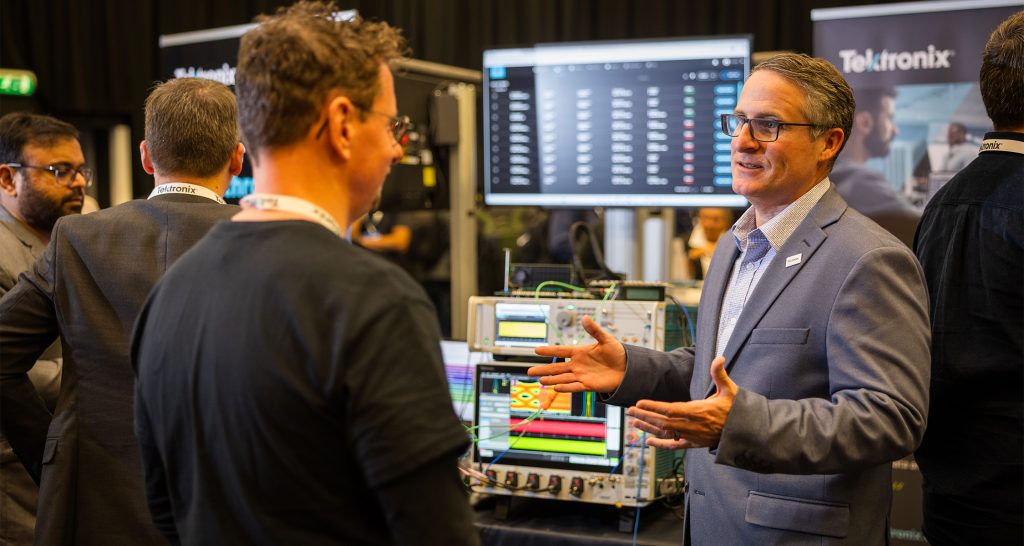
Kuhlman lives in Nashville with his wife, Jamie, and young daughters, Ella Katherine and Charlotte. He works as the general manager of software for Tektronix, a Portland, Oregon- based international company that develops electronic test and measurement products. In an industry that has historically been hardware-based, Kuhlman focuses on software, digital products, and artificial intelligence (AI).
‘Start-Uppy Flair’
Kuhlman landed his first job out of college—at National Instruments (NI) in Austin, Texas—thanks to a job fair on campus.
Years later, when NI announced an employee pay cut due to the sluggish economy, Kuhlman and some buddies decided they’d create and market iPhone apps to make some extra cash.
In time, Kuhlman left NI to devote himself full-time to app development and software/hardware startups, and he moved back to Tennessee.
In 2009, Kuhlman founded Kuhlmanation LLC, an iPhone app development company that would go on to release more than 20 apps, with one rising to No. 1 in the entertainment category and No. 5 overall in the app store. Over the next decade, Kuhlman also provided tech expertise to several other startups, including Havenlock, a smart lock company promoted on the TV show “Shark Tank;” Splitsecnd, a vehicle plug-in for two-way emergency communication, crash detection, and GPS capabilities; and Invodo, which created products and services for video in eCommerce.
He was working with another startup, Initial State, a cloud-based streaming and visualization platform, when Tektronix acquired the company.
“Tektronix is an 80-year-old tech company in test and measurement, a tried-and-true albeit risk-averse industry,” Kuhlman said. “I bring a lot of ‘start-uppy flair’—a new school software perspective—to a very old-school industry.”
Vol from the Start
Kuhlman grew up in Knoxville in a family of UT alumni. His father, also Rick Kuhlman, earned his bachelor’s degree in industrial engineering from UT in 1973, and his mother, Beverley, earned her bachelor’s in education from UT in 1974 and returned for her master’s degree in 1981.
While being a Vol was always the plan, engineering was not.
Kuhlman arrived on campus thinking he’d eventually go to medical school. But because he’d always been interested in electronics and mechanical gizmos, he chose engineering as his major.

“I lost the desire to be a doctor because I was so interested in engineering, either mechanical or electrical,” he said.
After talking with his cousin, the late Robert Rochelle (BS/EE ’47), UT professor emeritus in the Department of Electrical and Computer Engineering who was noted for his work on spacecraft instrumentation, Kuhlman decided on electrical engineering.
Kuhlman says UT gave him a solid foundation for his career. And now he’s trying to return the favor; in May 2025, Kuhlman joined the industrial advisory board for the Min H. Kao Department of Electrical Engineering and Computer Science.
‘Stay Curious’
“Tektronix builds tools that are sophisticated and cool by themselves,” Kuhlman said. “But the coolest thing I get to do is build tools for other engineers who are creating the leading edge of technology.”
From smart phones to electric vehicles to spacecraft to AI to “anything awesome in the technology world, Tektronix has surely touched that thing along the way.”
His latest project: Harnessing the power of AI.
“Part of my job is to teach people how to use AI for complicated engineering tasks,” he said. “If you use it properly and give it full context, you can make it do really sophisticated things.”
Imagine, he said, going from “AI, help me write a recipe for bread” to “AI, bake the bread.”
To do that, “AI will have to know the recipe and also be able to manipulate tools, in both real and digital spaces.”
He knows some people are fearful of AI or worried it may “steal” their jobs.
His advice: “Lean in and figure out how to make AI work for you. And stay curious. If you are curious, anything you can think of, you can do. That’s what AI brings to the table.”