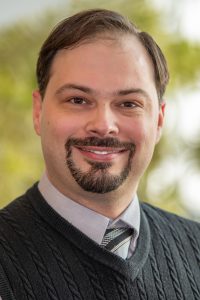
 Lonnie Crosby considers himself a problem solver. He enjoys helping people find solutions and making them more comfortable using high-performance computing (HPC) systems.
That made joining the Campus Champions program three years ago an easy decision for Crosby, the scientific computing group leader at the University of Tennessee’s National Institute for Computational Science (NICS).
Campus Champions is a nationwide community of research computing and data professionals who serve as local advocates and experts for HPC and cyberinfrastructure resources at their home institutions. The primary goal of the program is to empower researchers and educators by providing them with knowledge and assistance needed to leverage national-scale computing resources.
Even before becoming an official Campus Champion for UT, Crosby was already serving in supporting roles on campus. He’s worked alongside faculty or assigned others to help with research projects that involve HPC systems.
“I think the role of a facilitator is very important. With a lot of faculty, they’re concentrated on their scientific domain research. Most of them just don’t have time to become experts in computer architecture or computational systems,” Crosby said. “I think having a facilitator who’s more knowledgeable in that work with them, as a collaborator, is definitely helpful in ensuring that the research can get done.”
Valuable HPC Resource
Crosby, who has a PhD in computational chemistry, has more than 18 years of experience serving in high-performance computing roles. Between 2016–2021, the Tickle College of Engineering and the College of Arts and Sciences collaborated to fund his group for help with nearly 20 projects that involved HPC systems.
Crosby assisted Associate Professor Stephanie TerMaath, the Jessie Rogers Zeanah Faculty Fellow in the Department of Mechanical and Aerospace Engineering, with one of her projects.
“Lonnie contributed a unique expertise to the project allowing us to perform advanced computational analysis above and beyond the original plan,” TerMaath said. “Additionally, he was an exceptional mentor to the students and provided opportunities for them to gain hands-on experience with advanced computational capabilities.”
UT currently has a $5 million grant from the U.S. National Science Foundation for a project called CIREN, which is a five-year program that collaborates with Arizona State University to recruit and train facilitators to work with faculty on projects that help them utilize HPC systems.
“I am available for people to contact me if they want help or consultation on using either our local high-performance computing resources, national resources, or resources through the NSF CIREN project,” Crosby said. “I’ve been able to help people understand how their work might translate to certain systems, or what gaps they might need to fill. I can also help people try out certain national resources or provide guidance in requesting an allocation.”
Contact
Rhiannon Potkey (rpotkey@utk.edu)