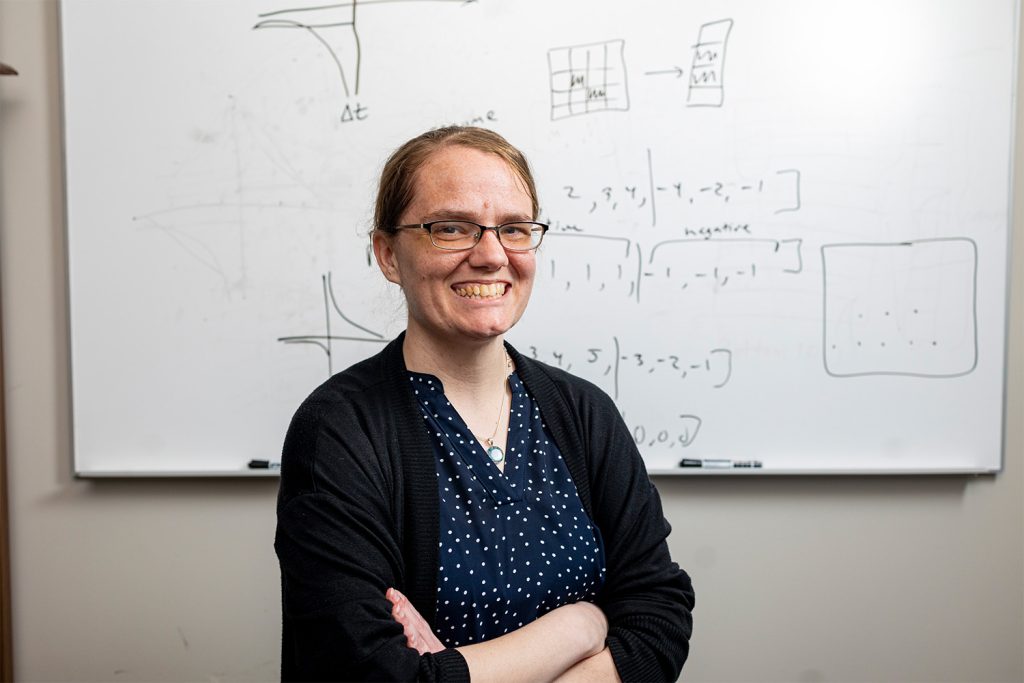
Catherine Schuman likely wouldn’t be on the same career trajectory if not for a conversation with Mark Dean.
As a PhD student in the Min H. Kao Department of Electrical Engineering and Computer Science in 2013, Schuman was focused on software-based neural network research. But after her advisor, Doug Birdwell, suggested meeting with Dean to discuss her work, Schuman’s focus shifted. She began exploring hardware-based neuromorphic systems.
Dean’s guidance was essential in helping Schuman become an expert in the field. Now an EECS assistant professor, Schuman co-leads the TENNLab Neuromorphic Computing Research Group at UT that Dean, Birdwell, and Schuman co-founded.
It seems only fitting then that Schuman has been named the inaugural EECS Mark Dean Fellow.
Funded by Tickle College of Engineering alumnus Dwight Hutchins (BS/CBE, ’86) and the IBM International Foundation, the Mark Dean Fellow was established to honor Dean and his contributions to the university and the computing industry.

“I’m very, very honored,” Schuman said. “Obviously, his career is unbelievable with all the things he’s been able to accomplish. Even if I didn’t know him personally, I would be honored. But knowing him as a friend and collaborator, it’s even more meaningful.”
Dean, an emeritus professor, was the John Fisher Distinguished Professor at UT from 2013 until his retirement in 2019. One of a small number of IBM Fellows, Dean is also a former interim dean of the college. Earlier this year, Dean was honored as part of the inaugural EECS Hall of Fame class.
Dean’s research and teaching focused on advanced computer architecture, data centric computing, and computational sciences. Dean holds three of the original nine patents for the IBM personal computer on which all PCs are based. One of his landmark inventions, the Industry Standard Architecture (ISA) bus, permits add-on devices like keyboards to connect with a computer’s motherboard. Dean was recognized for this achievement with his 1997 election to the National Inventors Hall of Fame.
Having seen all the work Schuman’s accomplished in the field over the years, Dean couldn’t think of a better candidate to be named the inaugural Mark Dean Fellow.
“Due to Dr. Schuman’s leadership and innovations, the EECS department was able to establish itself as a leader in neuromorphic computing and key computer learning methods,” Dean said. “I am very appreciative of her hard work and insights in this emerging technology.”
Dating back to her graduate studies at UT, Schuman is part of five patents with Dean. She still values every chance she gets to interact with him and hopes to make a similar lasting impact on her own students.
“It has already been one of the great honors to have collaborated with him as a PhD student,” Schuman said. “I’m just grateful for everything he’s done for the college and our department. I aspire to be able to contribute and give back at the same level that he has.”
Contact
Rhiannon Potkey ([email protected])