
Taufer’s Tool Lets Tennessee AI Control New York Beamline
Photo above courtesy of Cornell University.
Mathworks Professor Michela Taufer helped with what may be the world’s first structural material assessment conducted in two locations simultaneously.
Taufer leads the University of Tennessee’s Global Computing Laboratory (GC Lab), which includes Assistant Research Professors Jack Marquez and Kin NG. The GC Lab is a founding member of the National Science Data Fabric (NSDF), a National Science Foundation (NSF)-supported suite of software tools and data repositories that centralizes many aspects of the modern scientific workflow—including real-time visualization of data from multiple federal imaging instruments, data sharing between institutions, and post-experimental data storage, processing, and analysis.
This June, Taufer’s team collaborated with partners at the University of Utah, Cornell University, and Oak Ridge National Laboratory (ORNL) to add geographically distributed, AI-guided, real-time autonomous experimentation to the NSDF portfolio.
Earlier this month, the researchers moved real-time experimental data through NSDF to connect a Cornell High Energy Synchrotron Source (CHESS) beamline with ORNL’s infrastructure for autonomous workflows, enabling real-time active learning to recommend the next measurements during a residual-strain mapping experiment.
“In our experiment, AI-based active learning used each new measurement to update a model of the (material sample) and recommended the next most informative location to measure,” Taufer explained.
This effort highlights the interdisciplinary coordination required to connect universities, national laboratories, and federal science investments supported by the NSF and the United States Department of Energy (DOE), bringing together contributions from UT; Valerio Pascucci and Giorgio Scorzelli at the University of Utah; Amy Gooch at VISOAR LLC; Marshall McDonnell, Viktor Reshniak, Chris Fancher, Stephen DeWitt, and Lance Drane at ORNL; and Werner Sun, Amlan Das, Rolf Verberg, and Keara Soloway at CHESS, whose beamline integrations helped connect the data acquisition system, data analysis software, and strain-map outputs to the active-learning loop.
Building on Previous Success
Taufer hopes to establish the NSDF as a comprehensive, closed-loop workflow that handles data from the moment it comes in from an experimental facility through its end-user data analysis.
ORNL’s infrastructure for autonomous workflows, INTERSECT, includes an active-learning service called DIAL that uses incoming measurements from instruments to recommend the locations where the next measurement should be taken for maximum impact.
The Structural Materials Beamline (SMB) at CHESS supports the high-energy X-ray characterization of structural materials. Scientists can use SMB to map strain within components, helping them understand how to improve those parts and materials in the future.
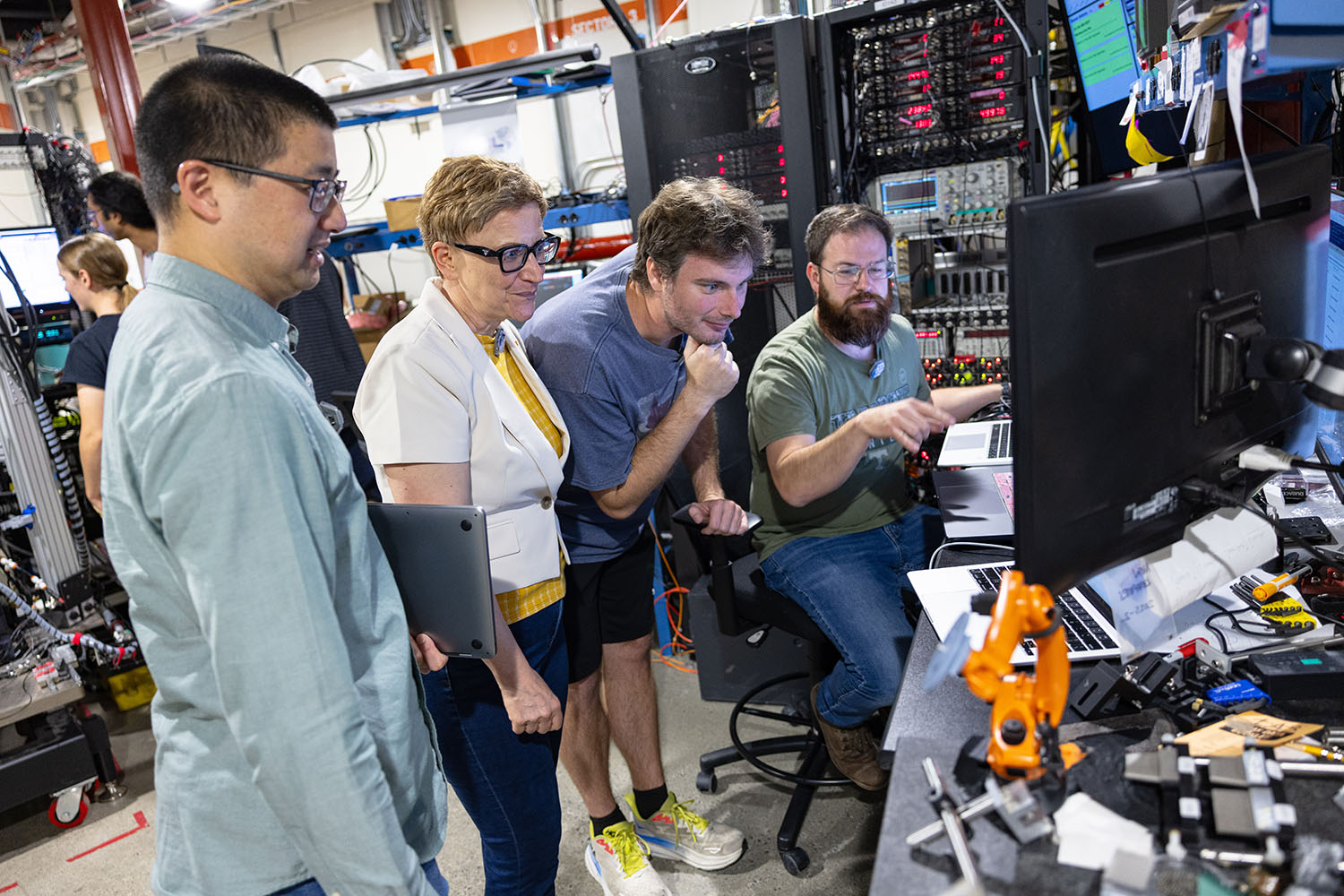
Image courtesy of Cornell University.
Such instruments usually scan samples in a predefined grid pattern, building a map of internal strain using regularly spaced locations. While this method is reliable, it can take days to build a detailed enough model of the component under investigation—and it’s also not usually possible to analyze that data during the experiment, so researchers are limited in their ability to react and adapt if something unexpected comes up during the scan.
“The goal was to obtain an accurate strain map with fewer measurements and make more efficient use of limited beam time,” Taufer said. “In prior strain-mapping studies, related active-learning approaches have reduced measurement time to approximately one-third of the time required by traditional mapping methods.”
A 4-Hour Flight; Real-Time Experiment Driving
During this month’s experiment, Taufer, Marquez, NG, and their colleagues demonstrated that NSDF can support real-time, AI-guided experimental workflows over large distances and between multiple institutions.
Beamline scientists at CHESS loaded SMB with an additively manufactured stainless steel wall. As SMB instruments scanned the wall, the collected data were shuttled to INTERSECT via the NSDF. Next, DIAL used the incoming data to create, maintain, and update an AI-driven model of the strain within the metal.
Once DIAL had a recommendation for the next measurement location, that information traveled through NSDF back to the SMB, which adjusted accordingly and continued gathering new data in the new location.
All the while, the investigators used NSDF-supported services and dashboards to monitor the process from their respective offices in Utah, Tennessee, and New York.
“NSDF provides the integration layer that enables data to move between experimental facilities, computing systems, analysis services, and users while supporting reproducible and reusable workflows,” Taufer said.
Contact
Izzie Gall ([email protected])