
Phillip Graham Uses Senior Design to Improve Kanji Education
During their final year, Engineering Vols undertake a senior design project, flexing their hard-earned skills to solve real problems faced by private companies, government laboratories, and other sponsors.
For Phillip Graham (BS/CompE, ’26; BA/Japanese, ’26), it was a dream come true.
“This project is something that’s been stewing in the back of my head for years upon years,” he said.
The Min H. Kao Department of Electrical Engineering and Computer Science (EECS) lets seniors pitch their own projects. If approved, the pitch receives department funding and other students can join the team just like an externally sponsored project.
Graham started teaching himself Japanese in high school. He was intrigued by the language’s beautiful and complex writing system, which consists of thousands of unique characters called kanji.
As he began learning the extremely precise characters, laboriously copying them into composition notebooks, the budding computer engineer knew there had to be a more effective way.
“I probably spent the first year of learning Japanese just trying to figure out how to learn Japanese,” he said.
During his time on Rocky Top, Graham double majored in computer engineering and Japanese, eventually reaching the second-highest fluency level recognized by the Japanese government. He tried a few times to create a tablet-based kanji learning tool, but was never satisfied with the result.
Then, last fall, Graham got the chance to ‘sponsor’ a team to help him build out the study aid of his dreams. The team’s final product, Kakudachi (Japanese for “writing buddy”), uses artificial intelligence integration to adaptively expand on a student’s existing knowledge to increase their vocabulary and kanji skills at a sustainable pace.
It is also an exceptional showcase of the hardware and software expertise EECS Engineering Vols develop during their time at UT.
“The motivation for this project was very unique, but I was still building upon the skills I had learned in EECS or still wanted to learn,” said Carmen Palileo (BS/CompE, ‘26), one of Graham’s teammates. “It was a lot of, ‘I don’t know this, but I’m going to try anyway; I’m going to learn something new.’”
Kanji Easily Overwhelms Students
When Graham began learning Japanese, he quickly grew frustrated with flashcard-based tools, which offer no feedback on stroke order—a vital aspect to writing kanji correctly.
“Some kanji include more than 30 strokes, and each one of those has their own specific direction and writing order,” Graham explained. “I know a lot of people who’ve studied Japanese who basically just skipped over learning how to write, because it appears at first to be an insurmountable task.”
In high school, Palileo was equally intrigued and intimidated by the complex writing system. She spent many long study sessions immersed in the music of Vocaloid, a singing synthesizer tool with a cast of digital characters personifying each ‘voice.’
Though most of the music videos she loved were in Japanese, the native language of the tool, Palileo thought the language seemed too time-consuming to learn.
“I joined Phillip’s project because I thought that maybe through this tool, I’d be able to understand the songs I listened to so much as a kid,” Palileo said.
Building Graham’s Dream Device
Graham challenged his teammates to help him create a device that could recognize a student’s handwritten kanji and provide feedback on stroke order, direction, and placement—while also increasing their overall understanding of the language.
Because many complex kanji are made of simpler characters, the team created a treelike tutoring architecture that allows a user to unlock new phrases and characters by mastering their components. They also integrated their app database with a large language model, creating an effectively bottomless source of new practice prompts.
“Kakudachi searches against thousands of nodes in the database to see what knowledge you currently possess, presents you the ability to gain new materials, and then iterates through the system such that you never see something you have no ability to understand,” Graham explained. “The fact that it’s able to do that shortest-path search to find the next thing you should learn in real time is an end result I’m very happy with.”
The team also flexed their hardware skills in creating Kakudachi, reverse-engineering an off-the-shelf power board to keep the device powered while tilted at a natural writing angle.
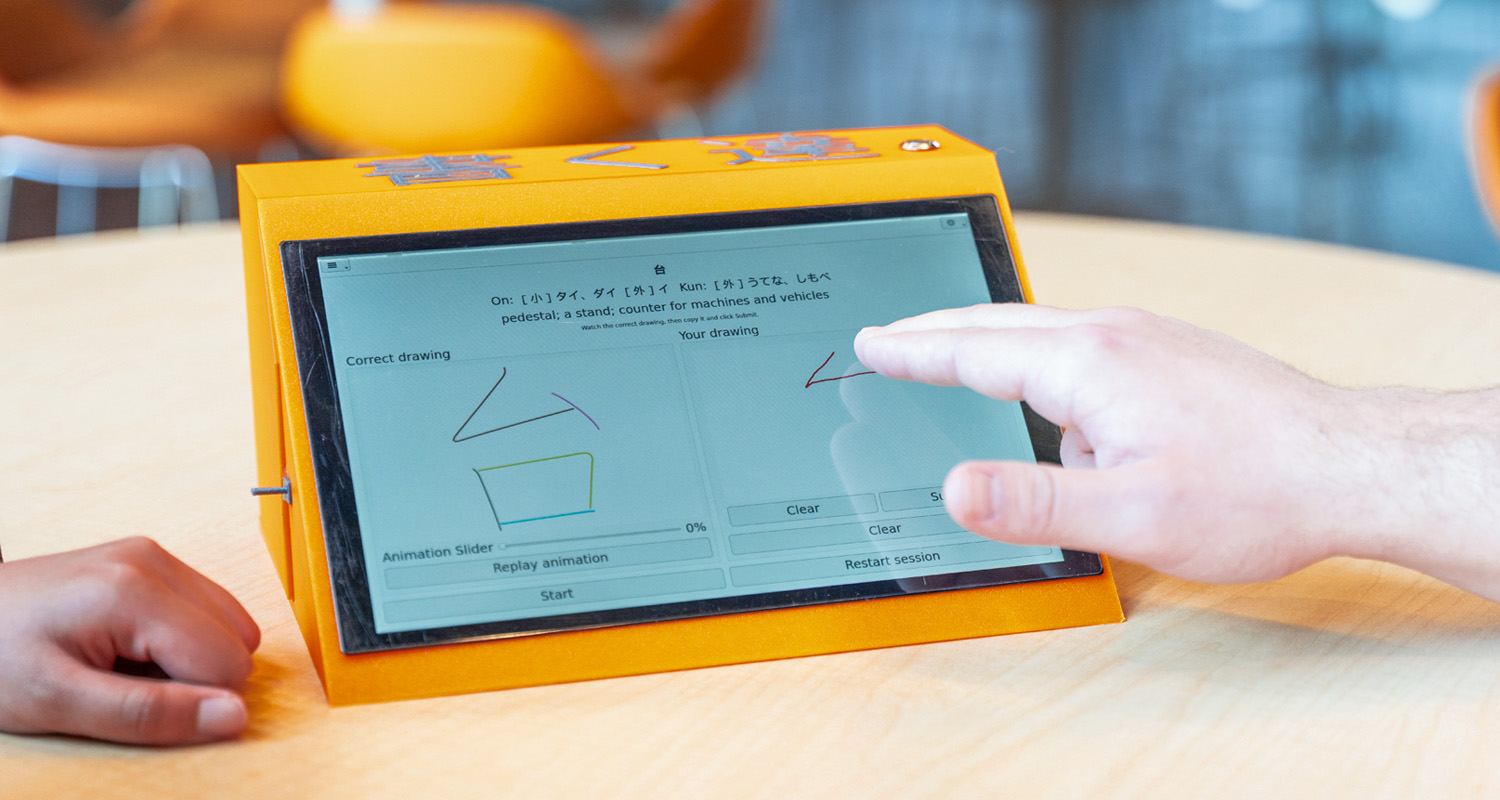
Palileo is delighted with the device’s real-time responsiveness, sleek 3D-printed case, and smooth graphical user interface.
Most of all, though, she and her teammates are thrilled with how well Kakudachi streamlines the learning process for one of the most complex writing systems in the modern world.
“You could start with someone who’s never seen this language in their life, or you could hand it to someone who’s been studying it for five years, and they’d probably both really enjoy using it,” Palileo said. “Being able to share our project with other students was really satisfying, because it solved a problem we didn’t know they had.”
While the Kakudachi teammates have left Rocky Top for jobs across the country, they have been considering expanding the technology to other languages with complex writing systems, like Mandarin and Cantonese, and adapting it to a widely usable iOS or Android mobile application.
“When I was learning kanji, I found a methodology that worked for me, and that I thought could work well for other people,” Graham said. “Kakudachi is meant to encapsulate that methodology into one full system that someone could just purchase or download. I tried to pour all my accumulated experience into this project.”
Contact
Izzie Gall ([email protected])